Showing posts with label Internment of Japanese-Canadians. Show all posts

Tuesday, May 21, 2019

May 21


I gave back your Unit 2 WRA II Essays today in class. I also gave you the Unit 3 WRA II essay question sheet today. We'll work in small groups tomorrow to work on argumentation and evidence. It's probably a good idea to look over the sample essays that are on the Social 20-1 wiki under WRA II Essay Writing. If you missed class today, you can send me an email to ask for the essay question sheet so you can get the essay prompt. 

I finished the lecture on "Internationalism and Nationalism" today as well. Start working on your Chapter 11 Key Terms and Questions as well. 


Today's theme was illiberalism. I defined this term for you, and focused on times when democratic countries infringed on the rights of their citizens during times of crisis. I talked briefly about the War Measures Act and how it was only to be used during times of war, invasion, or insurrection. I talked briefly about the internment of "enemy aliens" in WW I, and the internment of Japanese-Canadians during WW II. It is strongly recommended that you review the lecture on the internment of Japanese-Canadians during WWII on pages 267-271 in the Social 30-1 course books. I showed you a documentary from the Turning Points of History series on the FLQ Crisis. As you were watching this video, you should have filled in the blanks and answer the questions in the course book. You're writing the Unit 3 WRA II Essay on Wednesday, May 22nd, please go directly to the Blenheim Room tomorrow.  On Friday, May 24th you will be writing your Chapter 10 Test, you can find the study guide below. Your Civil Rights Movement Assignment (page 263 in the course book) is due on Friday, May 24th as well. 


This test is multiple choice format, with 55 questions. Please review the PowerPoint "Political Challenges to Liberalism". You're responsible for all key terms and questions from the Chapter 10 Worksheet. Please review the following as well: 


  • Democratic Systems (handout notes)
  • Non-Democratic Systems (handout notes)
  • Structure of Canadian Government
  • Structure of American Government
  • similarities/differences between the parliamentary system and presidential system
  • types of dictatorships
  • techniques of dictatorships
  • authoritarian systems
  • proportional representation concept
  • first past the post system
  • review political and economic spectrum (again!)


Wednesday, April 03, 2019

April 3


I went through part of the "20th Century Rejections of Liberalism" PowerPoint lecture. You need to go through the Nazi Germany part of the presentation on your own. I still have letters to switch from 30-1 to 30-2, so if you want to switch, please pick up the letter from me so we can the paperwork completed. You were supposed to pick up the Unit 2 WRA I Chart Assignment today this assignment is due on Friday, April 5th (unless you're switching to 30-2). On Monday, April 8th, you're writing the Unit 2 WRA I (unless you're switching to Social 30-2, then I'll be teaching how to do the WA I, and you'll complete one in class). On Tuesday, April 9th, you're writing the Chapter 5 Test in class, please see the study guide below.

The Chapter 5 Test will be on Tuesday, April 9th. It is a 70 multiple choice question test (but it will be reduced down in number on the day). Please review the following:

  • "20th Century Rejections of Liberalism" (ppt)
  • Marx notes (see 30-1 booklet)
  • Lenin notes (see 30-1 booklet)
  • Stalin notes (see 30-1 booklet)
  • Soviet Economy notes
  • Soviet Economic System notes
  • Changes to Soviet Society After Stalin notes
  • Gorbachev to Collapse notes
  • Economic Planning in the USSR booklet
  • Characteristics of Democracy
  • Characteristics of Dictatorship
  • Democratic Systems notes
  • Non-Democratic Systems notes
  • Types of Dictatorships notes (includes Techniques of Dictatorships as well)
  • A Comparison of Communism and Fascism notes
  • Totalitarianism notes
  • Fascism/Nazism booklet (has techniques of dictatorship in Nazi Germany and USSR)
  • do a brief review of the political and economic spectrums

The following key concepts/key events/key people are mentioned in this test, if you (re-)familiarize yourself with them it will help you out immensely!
  • centrally planned economies
  • initiative
  • FDR and the New Deal
  • Reaganomics
  • consumer sovereignty
  • invisible hand
  • Keynesian economics
  • laissez faire economics
  • War Communism
  • Five Year Plans
  • mixed economies
  • indicative planning
  • proportional representation
  • democracy
  • dictatorship
  • political spectrum (characteristics associated with the various ideologies)
  • status quo
  • egalitarianism
  • conservative
  • reactionary
  • liberal
  • radical
  • SA
  • Hitler
  • Bolshevik
  • fascism
  • communism
  • indoctrination
  • controlled participation
  • terror and force
  • direction of popular discontent
  • democratic socialists
  • supply-side economics
  • authoritarian
  • tyrant
  • totalitarian
  • totalitarianism
  • ultranationalism
  • nationalization
  • privatization
  • propaganda
  • progressive taxation
  • Marx
  • Lenin
  • utopian socialism
  • Gorbachev
  • martial law
  • Reichstag (Reichstag Fire, Reichstag election results)
  • referendum
  • collectivization
  • modernization
  • classical liberal
  • laissez faire free market economy
  • mixed economy
  • planned economy
  • (review your economic political quadrant model)
  • Das Kapital
  • Mein Kampf
  • The Wealth of Nations

I showed you a documentary called  "Tides of War" which focuses in on the internment of Japanese-Canadians in WWII. Please make sure that you're reading in your Social 20-1 course books about World War II, the classes will make more sense if you're keeping up with the readings. Your Chapter 6 Key Terms and Questions are due on Friday. 

On Monday, April 8th, you'll be writing the Chapter 5-6 Test. Please see the study guide below. 

This test will have a matching section, and a long answer section.

1. Study the following key concepts/key people/key events:

  • Archduke Franz Ferdinand
  • Triple Alliance
  • Triple Entente
  • the Black Hand
  • Gavrillo Princip
  • Tsar Nicholas II
  • Kaiser Wilhelm II
  • Battle of Tannenberg
  • the Schlieffen Plan
  • Plan 17
  • General von Moltke
  • Battle of the Marne
  • Alsace and Lorraine
  • total war
  • Battle of Verdun
  • Battle of the Somme
  • the Brusilov Offensive
  • sinking of the Lusitania
  • the Zimmermann Telegram
  • Treaty of Brest-Litovsk
  • General Ludendorff
  • Friedrich Ebert
  • Paris Peace Conference
  • David Lloyd George
  • Woodrow Wilson
  • Fourteen Points
  • Georges Clemenceau
  • Vittorio Orlando
  • League of Nations
  • plebiscites
  • reparations
  • collective security
  • war debts
  • Treaty of Versailles
  • "war guilt clause"
  • "Manchurian Incident"
  • Greater East Asian Co-Prosperity Sphere
  • expansionism
  • Hirohito
  • Hideki Tojo
  • Benito Mussolini
  • Adolf Hitler
  • Kristallnacht
  • the Nuremberg Laws
  • any of the key concepts or key events in the Interwar Years booklet is also testable material

2. Look at what I have emphasized in class (Causes of WWI, nature of WWI, armistice, Paris Peace Conference, Treaty of Versailles, the Interwar Years, rise of ultranationalism in Germany, Italy and Japan): this will be the emphasis of the test, there are several topics in your textbook Chapters 5-6 that WILL NOT be on this test, especially if it is event that occurs AFTER the events listed above (so things like Canada's role in Afghanistan, and Arctic sovereignty won't be on the test)

3. Focus your review on the following big concepts:

  • MAIN Causes of World War I
  • the nature of World War I (trench warfare, stalemate, total war)
  • the Paris Peace Conference (national interests in negotiating the treaties)
  • Woodrow Wilson's Fourteen Points (links on the blog, under Social 20-1 Links, CHECK IT OUT!!)
  • the Treaty of Versailles (terms of the Treaty of Versailles: GARGLe)
  • Hitler's violation of the Treaty of Versailles (chronology; order of events that violated the terms of the Treaty of Versailles)
  • the Interwar Years (key events, study your Interwar Years notes from the Social 20-1 course book)
  • the League of Nations (FAILURe of the League of Nations; be able to link to the Japanese invasion of Manchuria, and the Italian invasion of Abyssinia)
  • ultranationalism in Germany, Japan and Italy
  • failure of collective security (League of Nations) in Manchuria, Abyssinia, and the Spanish Civil War
  • appeasement of Adolf Hitler (Munich Conference, Neville Chamberlain, a foreign policy response to ultranationalism) 

Wednesday, April 04, 2018

April 4


You wrote your Chapter 7 Test today, hopefully you'll get the results back this week. Please remember that you're writing your Unit 2 WRA I in the Blue Lab in the Library tomorrow, so please go there directly.


We looked at the aftermath of the Japanese attack on Pearl Harbor today. The focus was mainly on the internment of Japanese-Canadians in WWII. There's a PowerPoint lecture in your Social 20-1 coursebook that I recommend you read over, and I showed a documentary today called "Tides of War".  The Chapter 5-6 Test is on Thursday, April 5th (tomorrow)
1. Study the following key concepts/key people/key events:

  • Archduke Franz Ferdinand
  • Triple Alliance
  • Triple Entente
  • the Black Hand
  • Gavrillo Princip
  • Tsar Nicholas II
  • Kaiser Wilhelm II
  • Battle of Tannenberg
  • the Schlieffen Plan
  • Plan 17
  • General von Moltke
  • Battle of the Marne
  • Alsace and Lorraine
  • total war
  • Battle of Verdun
  • Battle of the Somme
  • the Brusilov Offensive
  • sinking of the Lusitania
  • the Zimmermann Telegram
  • Treaty of Brest-Litovsk
  • General Ludendorff
  • Friedrich Ebert
  • Paris Peace Conference
  • David Lloyd George
  • Woodrow Wilson
  • Fourteen Points
  • Georges Clemenceau
  • Vittorio Orlando
  • League of Nations
  • plebiscites
  • reparations
  • collective security
  • war debts
  • Treaty of Versailles
  • "war guilt clause"
  • "Manchurian Incident"
  • Greater East Asian Co-Prosperity Sphere
  • expansionism
  • Hirohito
  • Hideki Tojo
  • Benito Mussolini
  • Adolf Hitler
  • Kristallnacht
  • the Nuremberg Laws
  • any of the key concepts or key events in the Interwar Years booklet is also testable material

2. Look at what I have emphasized in class (Causes of WWI, nature of WWI, armistice, Paris Peace Conference, Treaty of Versailles, the Interwar Years, rise of ultranationalism in Germany, Italy and Japan): this will be the emphasis of the test, there are several topics in your textbook Chapters 5-6 that WILL NOT be on this test, especially if it is event that occurs AFTER the events listed above (so things like Canada's role in Afghanistan, and Arctic sovereignty won't be on the test)

3. Focus your review on the following big concepts:

  • MAIN Causes of World War I
  • the nature of World War I (trench warfare, stalemate, total war)
  • the Paris Peace Conference (national interests in negotiating the treaties)
  • Woodrow Wilson's Fourteen Points (links on the blog, under Social 20-1 Links, CHECK IT OUT!!)
  • the Treaty of Versailles (terms of the Treaty of Versailles: GARGLe)
  • Hitler's violation of the Treaty of Versailles (chronology; order of events that violated the terms of the Treaty of Versailles)
  • the Interwar Years (key events, study your Interwar Years notes from the Unit 2 study booklet)
  • the League of Nations (FAILURe of the League of Nations)
  • ultranationalism in Germany, Japan and Italy
  • failure of collective security (League of Nations) in Manchuria, Abyssinia, and the Spanish Civil War
  • appeasement of Adolf Hitler (Munich Conference, Neville Chamberlain, a foreign policy response to ultranationalism) 


It is very timely that we are talking about the U.S. civil rights movement right now, since today marks the 50th anniversary of the assassination of Martin Luther King. Please have a look at the YouTube video that I have posted below. I finished off the PowerPoint lecture today that I started yesterday, and even had time to give you an idea of how difficult literacy tests were by having you write one in 10 minutes that was used in Louisiana to deny African-Americans to right to register to vote. We'll start the PBS documentary series "Eyes on the Prize" tomorrow.


Thursday, October 27, 2016

October 27


I showed you a documentary called "Tides of War" today, which covered the internment of Japanese-Canadians in WWII.You need to go through the rest of the PowerPoint on the internment of Japanese-Canadians in WWII that I started in class yesterday (I will not finish it off in class). I did a homework check on the questions for analysis from the Way of Subjects reading in your Social 20-1 workbooks today. 

On Monday, October 31st you'll be writing your Chapter 5-6 Test, please see the study guide below. 


1. Study the following key concepts/key people/key events:
  • Archduke Franz Ferdinand
  • Triple Alliance
  • Triple Entente
  • the Black Hand
  • Gavrillo Princip
  • Tsar Nicholas II
  • Kaiser Wilhelm II
  • Battle of Tannenberg
  • the Schlieffen Plan
  • Plan 17
  • General von Moltke
  • Battle of the Marne
  • Alsace and Lorraine
  • total war
  • Battle of Verdun
  • Battle of the Somme
  • the Brusilov Offensive
  • sinking of the Lusitania
  • the Zimmermann Telegram
  • Treaty of Brest-Litovsk
  • General Ludendorff
  • Friedrich Ebert
  • Paris Peace Conference
  • David Lloyd George
  • Woodrow Wilson
  • Fourteen Points
  • Georges Clemenceau
  • Vittorio Orlando
  • League of Nations
  • plebiscites
  • reparations
  • collective security
  • war debts
  • Treaty of Versailles
  • "war guilt clause"
  • "Manchurian Incident"
  • Greater East Asian Co-Prosperity Sphere
  • expansionism
  • Hirohito
  • Hideki Tojo
  • Benito Mussolini
  • Adolf Hitler
  • Kristallnacht
  • the Nuremberg Laws
  • any of the key concepts or key events in the Interwar Years booklet is also testable material

2. Look at what I have emphasized in class (causes of WWI, nature of WWI, armistice, Paris Peace Conference, Treaty of Versailles, the Interwar Years, rise of ultranationalism in Germany, Italy and Japan): this will be the emphasis of the test, there are several topics in your textbook Chapters 5-6 that WILL NOT be on this test, especially if it is event that occurs AFTER the events listed above (so things like Canada's role in Afghanistan, and Arctic sovereignty won't be on the test) 

3. Focus your review on the following big concepts:
  • MAIN Causes of World War I
  • the nature of World War I (trench warfare, stalemate, total war)
  • the Paris Peace Conference (national interests in negotiating the treaties)
  • Woodrow Wilson's Fourteen Points (links on the blog, under Social 20-1 Links, CHECK IT OUT!!)
  • the Treaty of Versailles (terms of the Treaty of Versailles: GARGLe)
  • Hitler's violation of the Treaty of Versailles (chronology; order of events that violated the terms of the Treaty of Versailles)
  • the Interwar Years (key events, study your Interwar Years notes in your Social 20-1 study booklet)
  • the League of Nations (FAILURe of the League of Nations)
  • ultranationalism in Germany, Japan and Italy (common characteristics?)
  • failure of collective security (League of Nations) in Manchuria, Abyssinia, and the Spanish Civil War
  • appeasement of Adolf Hitler (Munich Conference, Neville Chamberlain, a foreign policy response to ultranationalism)


I showed you a video from the Turning Points of History series on Napoleon Bonaparte's invasion of Russia today, and while you watched the video you should have taken notes. I reviewed with you the 19th Century Political Spectrum. I also drew connections between the events that we have studied so far this semester: the Enlightenment, the American Revolution, the French Revolution, the Age of Napoleon, and what we will be studying in the next week or so, namely the Haitian Revolution and Forging the American Republic (Washington, Adams, Jefferson and Madison). Please check your e-mail, I've shared with you a Google Doc study guide link for Friday's Current Events Quiz #5. One week from today you'll be writing the French Revolution and Napoleonic Age Test, be see the study guide below. 


  • know the causes of the French Revolution (short term, long term, economic, political, social, intellectual)
  • know the structure of French society during the Old Regime
  • know Napoleon's domestic policy
  • know Napoleon's foreign policy (Continental System in particular)
  • know key battles in the Napoleonic Wars (results of the Battle of Trafalgar, Russian campaign, the Battle of Leipzig, and the Battle of Waterloo)
  • know chronology of key events in the French Revolution
  • know the chronology of key events in the Napoleonic Age
  • know the key players at the Congress of Vienna (country and representatives)
  • what were the major decisions of the Congress? what were the guiding principles at the Congress of Vienna
  • know the 19th century political spectrum (please see the graphic below; values and characteristics of the various positions on the spectrum; what groups are represented on the various positions on the spectrum?; what phases/accomplishments of the French Revolution are represented on the spectrum?)


Monday, May 16, 2016

May 16


I started Social 30-1 material today, so if you missed class today, you'll have some catching up to do this week. I gave everyone who came to class a Social 30-1 workbook for IB History students, that is yours to keep.

I reviewed the following content today:


  • 19th century political spectrum (and their view on change; along with some quick review of the French Revolution and the Napoleonic era, specifically the Congress of Vienna)
  • 20th century political spectrum (I also talked about classical liberalism = economic conservatism, modern liberalism, and the transition from classical liberalism to welfare capitalism to modern liberalism--which created the welfare state. Remember: welfare capitalism is synonymous with welfare state)
  • economic spectrum
  • the techniques of dictatorship
  • economic-political grid (democratic socialism, democratic capitalism, dictatorial socialism and dictatorial capitalism, plus examples of each)
  • economic values of a command economy, a mixed economy and a market economy
  • principles of individualism (PRICES) --remember principles of individualism = principles of liberalism (I also defined liberalism)
  • principles of collectivism (PRINCE)

Here is your homework assignment between now and when I see you next on May 19th: 
  • read, highlight, annotate the Ideology Notes in the Social 30-1 workbook (pages 5-10)
  • read, highlight and complete the individualism and collectivism charts on pages 11-15
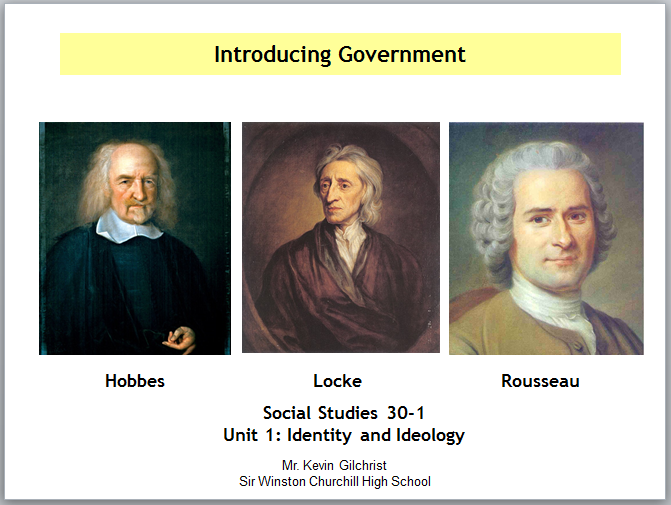
  • please print off (4 slides per page) of the following Unit 1 PowerPoint presentations: "Identity and Ideology" and "Introducing Government" (I'll go over this one in class on Thursday, May 19th)
  • you should read, highlight and annotate both of these presentations


(I'll go over Introducing Government in class on Thursday)


  • by Friday, May 20th you should be ready to go through the Unit 1 Review Prezi on the IB 30/35 wiki. 
  • scroll down on the navigation menu on the right-hand side of the wiki to find the Social 30-1 section to find all of the notes and PowerPoint presentations


Since we'd talked about the issue of resource development last week, I thought that it would be prudent to show you a video from the HBO series "Vice" and episode called "The Resource Curse" which examined a case study of an Exxon Mobil liquefied natural gas (LNG) project in Papau New Guinea, among others. I'm embedding this episode below.


In connection with watching "Shipbreakers" last week, and talking about the life cycle of a ship and the sustainability of the shipbreaking industry, I thought it would be interesting to look at another example of an industry that has environmental consequences that are sort of "out of sight, out of mind". I'm talking about e-waste. National Geographic Magazine had a feature on e-waste in their January 2008 issue that I would like you to read. Here is the hyperlink to the article: click here. I also showed you a short video on e-waste in China from the CBC News in Review. As you watched this video you should answered the video review questions. I gave you a copy of the Unit 4 Worksheet today as well. The Chapter 15 Key Terms and Questions are due next week on Wednesday, May 25th.

Please have a look at the upcoming important dates for Social 10-1 students: 

  • Unit 3 WRA II Essay is on Wednesday, May 18th (please look at the sample student essays on the Social 10-1 wiki)
  • Unit 3 Final Exam (the study guide goes up tomorrow on the blog)
  • Chapter 15-16 Test is on Thursday, June 2nd
  • Social 10-1 Final Exam Part A is on Wednesday, June 8th


We continued topics that we started last week, namely illiberalism (you can also use the Civil Rights Movement as a case study for undemocratic actions/illiberalism) and the usage of the War Measures Act. This legislation was only to be used in circumstances of war, invasion and insurrection. In Social 20-1, you should have discussed the treatment of "enemy aliens" in WWI, and the internment of Japanese-Canadians during WWII. Today, we covered the FLQ crisis of 1970 in which Quebec Premier Robert Bourassa called in Canadian Forces claiming that the Quebec provincial government was facing an "apprehended insurrection". We watched a video from the Turning Points of History on the FLQ Crisis. As you watched this video, you should have filled in the blanks for the film study sheet in your Social 30-1 booklets.

I also did a homework check on Chapter 9 Key Terms and Questions, and the Civil Rights Movement Assignment at the beginning of class. Your Chapter 11 Key Terms and Questions are due tomorrow. You're writing your Unit 3 WRA I (if you're in 30-1) on Thursday. Social 30-2 students will be writing an Assignment 3 (three citizens question).


Wednesday, April 01, 2015

April 1


I gave you back your results for your Market and Mixed Economy Test today. I went through some material from your Social 30-1 study booklet:

  • I finished off the Democratic Systems handout
  • Non-Democratic Systems
  • Types of Dictatorships
  • Totalitarianism
Please remember that you are writing your Economic Systems Exam on Tuesday, April 7th. Please see the study guide below.


This exam will be written on Tuesday, April 7th. It is a multiple choice question format test.
This is a comprehensive exam that covers all of the major economic systems: market economy, mixed economy, and command economy. It is 70 multiple choice questions.
  • Chapters 3-6 in Perspectives on Ideology
  • study the applicable PowerPoint presentations that are on the wiki under Unit 2 (check your notes): The Development of Classical Liberalism, Responding to Classical Liberalism, The Evolution of Modern Liberalism, 20th Century Rejections of Liberalism (just the USSR section of this PowerPoint)
  • In Chapter 5, just focus on the Soviet Union, and left-wing of economic spectrum (command economy), we haven't covered aspects of dictatorships or Nazism yet (the techniques of dictatorship and fascism will be on a Chapter 5 Test)
  • please see the summary notes from the Ideologies textbook: Chapter 7 (Private Enterprise), page 78-80 in the Social 30-1 study booklet 
  • supply-side economics (page 84 in study booklet)
  • boom and bust cycle/business cycle (pages 50-54 and pages 56-62 in 30-1 study booklet)
  • laws of supply and demand, Adam Smith, invisible hand, market forces
    self-interest, consumer sovereignty, competition, private ownership, profit motive
  • basic economic problems/questions
  • advantages/disadvantages of the market economy
  • causes of the Great Depression (pages 63-64 in 30-1 study booklet)
  • FDR and the New Deal
  • please see summary notes from the Ideologies textbook on the Mixed Economy Case Studies #14 (Sweden) and #15 (Canada), #16 (Japan), #17 (Fascism and Nazism): pages 73-76 in the study booklet
  • also see the Democratic Socialism booklet on Sweden (indicative planning, "cradle to the grave" economics/"womb to tomb economics"): pages 65-72 in 30-1 booklets
  • characteristics of a mixed economy
  • nationalization
  • privatization
  • democratic socialism
  • welfare capitalism
  • Keynesian economics
  • the business cycle and fiscal and monetary policies (study all of the notes I gave you)
  • demand-side economics
  • neo-conservatives
  • monetarism
  • trickle down economics
  • supply-side economics
  • Thatcherism and Reaganomics
  • Milton Friedman
  • Friedrich Hayek
  • how Keynesian economics deals with a recession (remember "the percolator": increase circulation of money reducing taxes, increase government spending on "make work" projects, and reduce interest rates, which according to Keynesian economics is going increase demand for goods and services and lead to more money circulating in the economy) pages 81-82 in the Social 30-1 study booklet 
  • how supply-side economics deals with a recession (remember "trickle down coffee maker": government should stimulate the goods and services sector of the economy by reducing corporate and personal taxes, eventually benefits will "trickle down" to the middle class and working class, make connections between supply-side economics and laissez faire economics/classical liberalism): pages 81-82 in the 30-1 booklet
  • advantages and disadvantages of a mixed economy
  • neo-conservative criticism of government intervention
  • characteristics of a centrally planned economy
  • advantages and disadvantages of a centrally planned economy
  • Marx notes (pages 94-96 in 30-1 booklet)
  • Lenin notes (pages 97-98 in 30-1 booklet)
  • establishment of the Soviet Union
  • Soviet economic system (top-down decision-making process): study pages 105-114 in the Social 30-1 booklet
  • Lenin's War Communism and the New Economic Policy
  • "Stalin and the Modernization of Russia" (see film notes)
  • Stalin notes (pages 99-101)
  • "Changes to Soviet Society After Stalin" notes (this bridges the gap between Stalin and Gorbachev): pages 116-117 in 30-1 booklet
  • Gorbachev to Collapse Notes: pages 118-121 in 30-1 booklet
  • Economic Planning in the USSR: pages 122-129 in 30-1 booklet
  • Market Socialism (pages 130-132 in the Social 30-1 booklet)


We finished watching "Tides of War" today. You also got to pick out your topics for the Unit 2 Research Project. Please remember that you're writing the Chapter 5-6 Test tomorrow, please see the study guide below.


1. Study the following key concepts/key people/key events:

  • Archduke Franz Ferdinand
  • Triple Alliance
  • Triple Entente
  • the Black Hand
  • Gavrillo Princip
  • Tsar Nicholas II
  • Kaiser Wilhelm II
  • Battle of Tannenberg
  • the Schlieffen Plan
  • Plan 17
  • General von Moltke
  • Battle of the Marne
  • Alsace and Lorraine
  • total war
  • Battle of Verdun
  • Battle of the Somme
  • the Brusilov Offensive
  • sinking of the Lusitania
  • the Zimmermann Telegram
  • Treaty of Brest-Litovsk
  • General Ludendorff
  • Friedrich Ebert
  • Paris Peace Conference
  • David Lloyd George
  • Woodrow Wilson
  • Fourteen Points
  • Georges Clemenceau
  • Vittorio Orlando
  • League of Nations
  • plebiscites
  • reparations
  • collective security
  • war debts
  • Treaty of Versailles
  • "war guilt clause"
  • "Manchurian Incident"
  • Greater East Asian Co-Prosperity Sphere
  • expansionism
  • Hirohito
  • Hideki Tojo
  • Benito Mussolini
  • Adolf Hitler
  • Kristallnacht
  • the Nuremberg Laws
  • any of the key concepts or key events in the Interwar Years booklet is also testable material

2. Look at what I have emphasized in class (Causes of WWI, nature of WWI, armistice, Paris Peace Conference, Treaty of Versailles, the Interwar Years, rise of ultranationalism in Germany, Italy and Japan): this will be the emphasis of the test, there are several topics in your textbook Chapters 5-6 that WILL NOT be on this test, especially if it is event that occurs AFTER the events listed above (so things like Canada's role in Afghanistan, and Arctic sovereignty won't be on the test)

3. Focus your review on the following big concepts:

  • MAIN Causes of World War I
  • the nature of World War I (trench warfare, stalemate, total war)
  • the Paris Peace Conference (national interests in negotiating the treaties)
  • Woodrow Wilson's Fourteen Points (links on the blog, under Social 20-1 Links, CHECK IT OUT!!)
  • the Treaty of Versailles (terms of the Treaty of Versailles: GARGLe)
  • Hitler's violation of the Treaty of Versailles (chronology; order of events that violated the terms of the Treaty of Versailles)
  • the Interwar Years (key events, study your Interwar Years notes from the Unit 2 study booklet)
  • the League of Nations (FAILURe of the League of Nations)
  • ultranationalism in Germany, Japan and Italy
  • failure of collective security (League of Nations) in Manchuria, Abyssinia, and the Spanish Civil War
  • appeasement of Adolf Hitler (Munich Conference, Neville Chamberlain, a foreign policy response to ultranationalism)  

Tuesday, March 31, 2015

March 31


You wrote your Market and Mixed Economy Test today in class. You'll get the results back tomorrow. Please remember that the Economic Planning in the USSR section in your Social 30-1 study booklets is due tomorrow. Your Economic Systems Test (command economy, mixed economy, and market economy) is on Tuesday, April 7th. Please see the study guide below.


This exam will be written on Tuesday, April 7th. It is a multiple choice question format test.
This is a comprehensive exam that covers all of the major economic systems: market economy, mixed economy, and command economy. It is 70 multiple choice questions.
  • Chapters 3-6 in Perspectives on Ideology
  • study the applicable PowerPoint presentations that are on the wiki under Unit 2 (check your notes): The Development of Classical Liberalism, Responding to Classical Liberalism, The Evolution of Modern Liberalism, 20th Century Rejections of Liberalism (just the USSR section of this PowerPoint)
  • In Chapter 5, just focus on the Soviet Union, and left-wing of economic spectrum (command economy), we haven't covered aspects of dictatorships or Nazism yet (the techniques of dictatorship and fascism will be on a Chapter 5 Test)
  • please see the summary notes from the Ideologies textbook: Chapter 7 (Private Enterprise), page 78-80 in the Social 30-1 study booklet 
  • supply-side economics (page 84 in study booklet)
  • boom and bust cycle/business cycle (pages 50-54 and pages 56-62 in 30-1 study booklet)
  • laws of supply and demand, Adam Smith, invisible hand, market forces
    self-interest, consumer sovereignty, competition, private ownership, profit motive
  • basic economic problems/questions
  • advantages/disadvantages of the market economy
  • causes of the Great Depression (pages 63-64 in 30-1 study booklet)
  • FDR and the New Deal
  • please see summary notes from the Ideologies textbook on the Mixed Economy Case Studies #14 (Sweden) and #15 (Canada), #16 (Japan), #17 (Fascism and Nazism): pages 73-76 in the study booklet
  • also see the Democratic Socialism booklet on Sweden (indicative planning, "cradle to the grave" economics/"womb to tomb economics"): pages 65-72 in 30-1 booklets
  • characteristics of a mixed economy
  • nationalization
  • privatization
  • democratic socialism
  • welfare capitalism
  • Keynesian economics
  • the business cycle and fiscal and monetary policies (study all of the notes I gave you)
  • demand-side economics
  • neo-conservatives
  • monetarism
  • trickle down economics
  • supply-side economics
  • Thatcherism and Reaganomics
  • Milton Friedman
  • Friedrich Hayek
  • how Keynesian economics deals with a recession (remember "the percolator": increase circulation of money reducing taxes, increase government spending on "make work" projects, and reduce interest rates, which according to Keynesian economics is going increase demand for goods and services and lead to more money circulating in the economy) pages 81-82 in the Social 30-1 study booklet 
  • how supply-side economics deals with a recession (remember "trickle down coffee maker": government should stimulate the goods and services sector of the economy by reducing corporate and personal taxes, eventually benefits will "trickle down" to the middle class and working class, make connections between supply-side economics and laissez faire economics/classical liberalism): pages 81-82 in the 30-1 booklet
  • advantages and disadvantages of a mixed economy
  • neo-conservative criticism of government intervention
  • characteristics of a centrally planned economy
  • advantages and disadvantages of a centrally planned economy
  • Marx notes (pages 94-96 in 30-1 booklet)
  • Lenin notes (pages 97-98 in 30-1 booklet)
  • establishment of the Soviet Union
  • Soviet economic system (top-down decision-making process): study pages 105-114 in the Social 30-1 booklet
  • Lenin's War Communism and the New Economic Policy
  • "Stalin and the Modernization of Russia" (see film notes)
  • Stalin notes (pages 99-101)
  • "Changes to Soviet Society After Stalin" notes (this bridges the gap between Stalin and Gorbachev): pages 116-117 in 30-1 booklet
  • Gorbachev to Collapse Notes: pages 118-121 in 30-1 booklet
  • Economic Planning in the USSR: pages 122-129 in 30-1 booklet
  • Market Socialism (pages 130-132 in the Social 30-1 booklet)


We looked at the internment of Japanese-Canadians today in class. I went through a PowerPoint lecture on this topic and started showing "Tides of War". We'll finish off the documentary on the internment tomorrow. Please remember that you're writing the Chapter 5-6 Test on Thursday, please see the study guide below.


1. Study the following key concepts/key people/key events:

  • Archduke Franz Ferdinand
  • Triple Alliance
  • Triple Entente
  • the Black Hand
  • Gavrillo Princip
  • Tsar Nicholas II
  • Kaiser Wilhelm II
  • Battle of Tannenberg
  • the Schlieffen Plan
  • Plan 17
  • General von Moltke
  • Battle of the Marne
  • Alsace and Lorraine
  • total war
  • Battle of Verdun
  • Battle of the Somme
  • the Brusilov Offensive
  • sinking of the Lusitania
  • the Zimmermann Telegram
  • Treaty of Brest-Litovsk
  • General Ludendorff
  • Friedrich Ebert
  • Paris Peace Conference
  • David Lloyd George
  • Woodrow Wilson
  • Fourteen Points
  • Georges Clemenceau
  • Vittorio Orlando
  • League of Nations
  • plebiscites
  • reparations
  • collective security
  • war debts
  • Treaty of Versailles
  • "war guilt clause"
  • "Manchurian Incident"
  • Greater East Asian Co-Prosperity Sphere
  • expansionism
  • Hirohito
  • Hideki Tojo
  • Benito Mussolini
  • Adolf Hitler
  • Kristallnacht
  • the Nuremberg Laws
  • any of the key concepts or key events in the Interwar Years booklet is also testable material

2. Look at what I have emphasized in class (Causes of WWI, nature of WWI, armistice, Paris Peace Conference, Treaty of Versailles, the Interwar Years, rise of ultranationalism in Germany, Italy and Japan): this will be the emphasis of the test, there are several topics in your textbook Chapters 5-6 that WILL NOT be on this test, especially if it is event that occurs AFTER the events listed above (so things like Canada's role in Afghanistan, and Arctic sovereignty won't be on the test)

3. Focus your review on the following big concepts:

  • MAIN Causes of World War I
  • the nature of World War I (trench warfare, stalemate, total war)
  • the Paris Peace Conference (national interests in negotiating the treaties)
  • Woodrow Wilson's Fourteen Points (links on the blog, under Social 20-1 Links, CHECK IT OUT!!)
  • the Treaty of Versailles (terms of the Treaty of Versailles: GARGLe)
  • Hitler's violation of the Treaty of Versailles (chronology; order of events that violated the terms of the Treaty of Versailles)
  • the Interwar Years (key events, study your Interwar Years notes from the Unit 2 study booklet)
  • the League of Nations (FAILURe of the League of Nations)
  • ultranationalism in Germany, Japan and Italy
  • failure of collective security (League of Nations) in Manchuria, Abyssinia, and the Spanish Civil War
  • appeasement of Adolf Hitler (Munich Conference, Neville Chamberlain, a foreign policy response to ultranationalism) 

Wednesday, April 03, 2013

April 3

A lot of yesterday's class was spent re-teaching how to write a three source analysis assignment (WRA I). I will be sending you a handout on how to write a WRA I as well today, so check your e-mail.

We did a quick review of the economic-political grid today. We continued looking at non-democratic systems today. We look at characteristics of non-democratic systems (handout) and types of dictatorships (handout). We also watched the A & E Biography called "The Fatal Attraction of Adolf Hitler". Please remember that you have your Economic Systems Exam tomorrow. You can find the study guide for this exam here. Your Economic Planning in the USSR booklet is due tomorrow.

I distributed a handout to you yesterday called "The Way of Subjects". The analysis questions are due tomorrow. We looked at the Japanese attack on Pearl Harbor yesterday, and the motivations for the attack. We watched a short excerpt from the film "Pearl Harbor" as well yesterday.

Today, we looked at the results of the attack on Pearl Harbor, namely the internment of Japanese-Canadians. I sent you a PowerPoint on this topic yesterday. Today, we completed a film study of the documentary "Tides of War" which looked at the internment. Your Chapter 5-6 Test is on Monday, April 8th, please see the study guide here (scroll down to find it).

Yesterday we started our examination of the U.S. Civil Rights Movement. I started a PowerPoint lecture on the U.S. Civil Rights Movement, which is already posted on the wiki. I also gave you a Social 30-1 U.S. Civil Rights Movement assignment. This assignment is due on Tuesday, April 9th.

We watched Episode 1 of "Eyes on the Prize" today. You were given a question sheet to go along with this episode, the questions from this worksheet are due tomorrow (April 4th). Episode 1 of "Eyes on the Prize" focused in on the murder of Emmett Till and the Montgomery Bus Boycott. On the timeline that is on the video study guide for this episode it also mentions the Brown v. Board of Education Supreme Court decision, however, the makers of Eyes on the Prize focus in on Emmett Till's murder, and the short public trial of his murderers. You can see Till's murder as a pivotal event in the Civil Rights Movement, and the open casket funeral of Emmett Till and the publication of the photos as a catalyst for change in America's attitudes. Mississippi, where Till's murder took place gained national notoriety as a hotbed for white supremacy as well. If you are interested in the Till case you might want to do a little investigation of your own into the impact that the murder had on popular culture. Numerous songs, plays, poems, novels, TV shows and movies have drawn inspiration from the murder of Emmett Till and the court case. You may see parallels between the Till case and Harper Lee's novel To Kill a Mockingbird (one of my personal favorites) to the TV show In the Heat of the Night (it was previously a movie too), to the Bob Dylan song "The Death of Emmett Till". With the Montgomery Bus Boycott segment of the episode you saw the emergence of Martin Luther King on the national stage. We'll be exploring his role and leadership in the movement in the days to come.

I also finished off the U.S. Civil Rights Movement PowerPoint lecture today. This presentation is on the IB 30/35 wiki already. It is strongly recommended that you print this presentation off and study from it as well.