Showing posts with label FLQ Crisis. Show all posts

Wednesday, December 04, 2019

December 4


We continued looking at the concept of illiberalism today, by going through another case study on the usage of the War Measures Act in Canadian history, namely, the FLQ Crisis of 1970. We watched a video from the Turning Points in History series on the FLQ Crisis, and while you were watching this video you should have completed the fill in the blanks film study activities. I also did a homework check on your Chapter 11 Key Terms and Questions. Please remember that the Civil Rights Assignment is due on Friday (just the front side of the assignment, questions 1-14). You're writing the Unit 3 WRA II position paper on Monday, December 9th (you'll get the essay question sheet in advance). One week from today (Wednesday, December 11th), you are writing the Chapter 10 Test (please see the study guide below).


  • This test is multiple choice format, with 55 questions. 
  •  Please review the PowerPoint "Political Challenges to Liberalism". 
  •  You're responsible for all key terms and questions from the Chapter 10 Worksheet. 

Please review the following as well: 

  •  Democratic Systems (handout notes) 
  • Non-Democratic Systems (handout notes) 
  • Structure of Canadian Government 
  • Structure of American Government 
  • differences between the parliamentary system and presidential system 
  • types of dictatorships 
  • techniques of dictatorships 
  • authoritarian systems 
  • proportional representation concept
  • first past the post system
  •  review political and economic spectrum (again!)


We started Unit 3 material today. I had you do a survey on internationalism today, as well starting a lecture on "Nations, Nation-States, and Internationalism". We'll finish off this lecture tomorrow. I also shared with you the upcoming key dates for Social 20-1 (please see below).


  • Unit 2 Final Exam is on Monday, December 9th
  • Unit 3 WRA II position paper is on Monday, December 16th
  • Unit 3 Final Exam is on Wednesday, December 18th
  • Social 20-1 Part A is on Wednesday, January 8th (it's a position paper)
  • Social 20-1 Part B is on Tuesday, January 14th 1-3 pm in the Main Gym (80 multiple choice questions)


I went through a lecture on the international response to German expansion (1933-1940), which obviously took us into WWII.


I gave you a Take Home Paper 1 to do tonight. Take 60 minutes to write it at home tonight. We'll be in small groups tomorrow going through and making a key. I will also give you sample responses to the question, and you will have to decide as a group what mark the student should have received. Please remember that your Paper 1 Assignment is due on Friday, December 6th. You should also complete the following note-taking chart.


Tuesday, May 21, 2019

May 21


I gave back your Unit 2 WRA II Essays today in class. I also gave you the Unit 3 WRA II essay question sheet today. We'll work in small groups tomorrow to work on argumentation and evidence. It's probably a good idea to look over the sample essays that are on the Social 20-1 wiki under WRA II Essay Writing. If you missed class today, you can send me an email to ask for the essay question sheet so you can get the essay prompt. 

I finished the lecture on "Internationalism and Nationalism" today as well. Start working on your Chapter 11 Key Terms and Questions as well. 


Today's theme was illiberalism. I defined this term for you, and focused on times when democratic countries infringed on the rights of their citizens during times of crisis. I talked briefly about the War Measures Act and how it was only to be used during times of war, invasion, or insurrection. I talked briefly about the internment of "enemy aliens" in WW I, and the internment of Japanese-Canadians during WW II. It is strongly recommended that you review the lecture on the internment of Japanese-Canadians during WWII on pages 267-271 in the Social 30-1 course books. I showed you a documentary from the Turning Points of History series on the FLQ Crisis. As you were watching this video, you should have filled in the blanks and answer the questions in the course book. You're writing the Unit 3 WRA II Essay on Wednesday, May 22nd, please go directly to the Blenheim Room tomorrow.  On Friday, May 24th you will be writing your Chapter 10 Test, you can find the study guide below. Your Civil Rights Movement Assignment (page 263 in the course book) is due on Friday, May 24th as well. 


This test is multiple choice format, with 55 questions. Please review the PowerPoint "Political Challenges to Liberalism". You're responsible for all key terms and questions from the Chapter 10 Worksheet. Please review the following as well: 


  • Democratic Systems (handout notes)
  • Non-Democratic Systems (handout notes)
  • Structure of Canadian Government
  • Structure of American Government
  • similarities/differences between the parliamentary system and presidential system
  • types of dictatorships
  • techniques of dictatorships
  • authoritarian systems
  • proportional representation concept
  • first past the post system
  • review political and economic spectrum (again!)


Thursday, December 06, 2018

December 6


Wednesday, July 25, 2018

July 25


We finished off watching "The FLQ Crisis" from the Turning Points in History series. You wrote your Chapter 10 Test  today as well. I showed you a CBC News in Review from 2006 that covered the 9/11 attack. We covered the USA PATRIOT Act quickly as well. Please make sure that you cover all of the Patriot Act content in your Social 30-1 coursebooks. We also looked at the issue of government surveillance. We started our film study of "Snowden", which we will continue tomorrow. 


  • Unit 3 Final Exam is on Thursday, July 26th (see study guide below)
  • Civil Rights Movement Assignment (due tomorrow)
  • Trial Final Exam is on Friday, July 27th (study guide is the same as for the Diploma Exam, it's at the back of your Social 30-1 coursebooks)


Please study the following material: 
  • make sure that you have read Chapters 9-12 in Perspectives on Ideology
  • study all key concepts from the Chapters 9-12 Worksheets (see below)
  • study all questions/answers from the Chapters 9-12 Worksheets
  • "Political Challenges to Liberalism" (PowerPoint presentation)
Review the following notes/packages:
  • Democratic Systems
  • Non-Democratic Systems
  • types of dictatorships
  • techniques of dictatorships
  • Civil Rights Movement
  • authoritarian systems (China notes)
  • review the economic and political spectrum (again!)
  • re-read the notes on rights that I put on the board (Charter of Rights and Freedoms to War Measures Act)
  • FLQ Crisis 1970
Know the following key concepts/key events/key terms/key people:
  • assimilation
  • self-interest
  • humanitarianism
  • Indian Act
  • residential school system
  • enfranchisement
  • the White Paper
  • the Red Paper
  • “war on terror"
  • authoritarianism
  • consensus decision-making
  • direct democracy
  • military dictatorship
  • oligarchy
  • one-party state
  • party solidarity
  • representation by population
  • proportional representation
  • representative democracy
  • responsible government
  • democracy
  • single-member constituency (first past the post)
  • the Senate
  • the House of Commons
  • the House of Representatives
  • the Senate
  • mixed-member proportional system
  • lobby groups
  • American Bill of Rights
  • Anti-Terrorism Act
  • Canadian Charter of Rights and Freedoms
  • emergency and security legislation
  • illiberal
  • language legislation
  • Bill 101
  • Bill 178
  • Bill 86
  • Quebec Charter of Human Rights and Freedoms
  • respect for law and order
  • terrorism
  • rendition
  • the War Measures Act
  • enemy aliens
  • internment
  • the Emergencies Act
  • USA PATRIOT Act
  • consumerism
  • environmental change
  • extremism
  • pandemics
  • postmodernism
  • global warming
  • Kyoto Protocol
  • World Health Organization (WHO)
  • drought

Monday, June 04, 2018

June 4


We continued with the concept of illiberalism today by looking at the FLQ Crisis of 1970. I gave you some background notes prior to showing you the video from the Turning Points of History series. We're not going to have the Unit 3 Final Exam tomorrow, and I'm moving the Social 30-1 Trial Final to this Thursday. The study guide for the Trial Final Exam is at the back of your coursebooks (pages 88-97). If you're curious about the textbook Perspectives on Ideologies, you can find the entire textbook on the IB 30/35 wiki.


We started a film study of "Contagion" today, which illustrated a fictional response to a global pandemic. We'll finish the movie off tomorrow. On Thursday, you will be writing Part A of the Final Exam, which counts for 10% of your final mark in Social Studies 10-1.


We were in a computer lab today, working in Google Doc groups. Each Google Doc group had a different essay source to analyze. I'll give each group some feedback on what they have written. Don't forget that you're writing the Unit 3 Final Exam tomorrow. You can find the study guide below. On Wednesday, you will write the Social Studies 20-1 Part A of the Final Exam in Room 104. This will count for 10% of your final mark in Social 20-1. Don't be late for class that day!


Please review all of the Unit 3 PowerPoint presentations (you can find them on the Social 20-1 wiki):
  • "Nations, Nation-States and Internationalism"
  • "Canada's Foreign Policy"
  • "Nationalism and Internationalism"
Please review all of the Unit 3 Key Terms from the Unit 3 Worksheet in addition to the key concepts that were introduced in the PowerPoint presentations. In addition to this, I would like to emphasize the following points with you:
  • know the difference between multilateralism, unilateralism and bilateralism and know examples of each
  • know the spectrum of foreign policy: internationalism, nationalism, ultranationalism, and supranationalism
  • know the different foreign policy options
  • know the 6 themes of Canadian foreign policy/Canada's foreign policy goals
  • what influences foreign policy decisions?
  • methods of foreign policy
  • motivations for nations involvement or non-involvement in international affairs
  • how can foreign policy promote internationalism?
  • tied aid, bilateral aid, multilateral aid
  • examples of INGOs and IGOs
  • the United Nations (organization/structure, bodies, etc.)
  • peacemaking vs. peacekeeping (and examples)
  • different understandings of internationalism (types of internationalism)
  • why do international organizations exist? purposes and examples


Monday, July 25, 2016

July 25


You wrote your Unit 2 WRA II Essay today in the Blenheim Room. I'd like to have these marked by Tuesday or Wednesday.  I gave you some notes on liberalism, illiberalism and the War Measures Act. The three situations in which the Canadian government could you use were war, invasion and insurrection. The War Measures Act was used three times in Canadian history: World War I (1914-1918), which led to the internment of so-called "enemy aliens". The War Measures Act is also used during World War II (1939-1945) to intern Japanese-Canadians in response to the Japanese surprise attack on Pearl Harbor on December 7, 1941. The Canadian federal government also used the War Measures Act in October 1970 during the FLQ Crisis, with the Quebec government claiming that they were facing an "apprehended insurrection". As you watched today's video from the Turning Points in History series, you were to complete the film study fill in the blanks. In today's video we looked at the FLQ crisis, this is the interview on the steps of Parliament that features Trudeau's "just watch me" speech. It's an interesting little debate that is waged being Trudeau and the reporters over the issue on giving up or losing civil liberties in order to ensure security.

Upcoming Important Dates: 

  • Chapter 10 Test is on Tuesday, July 26th
  • Chapter 9 Key Terms and Questions are due on July 26th
  • Civil Rights Assignment is due on July 26th
  • Unit 3 Final Exam is on Wednesday, July 27th
  • Unit 3 WRA I is on July 27th
  • Chapter 11 Key Terms and Questions are due on July 27th
  • Trial Final Exam is on Thursday, July 28th
  • Chapter 12 Key Terms and Questions are due on July 28th


Your Unit 3 Final Exam will be on Wednesday, July 27th. 
Please study the following material: 
  • make sure that you have read Chapters 9-12 in Perspectives on Ideology
  • study all key concepts from the Chapters 9-12 Worksheets (see below)
  • study all questions/answers from the Chapters 9-12 Worksheets
  • "Political Challenges to Liberalism" (PowerPoint presentation)
Review the following notes/packages:
  • Democratic Systems
  • Non-Democratic Systems
  • types of dictatorships
  • techniques of dictatorships
  • Civil Rights Movement
  • authoritarian systems (China notes)
  • review the economic and political spectrum (again!)
  • re-read the notes on rights that I put on the board (Charter of Rights and Freedoms to War Measures Act)
  • FLQ Crisis 1970
Know the following key concepts/key events/key terms/key people:
  • assimilation
  • self-interest
  • humanitarianism
  • Indian Act
  • residential school system
  • enfranchisement
  • the White Paper
  • the Red Paper
  • “war on terror"
  • authoritarianism
  • consensus decision-making
  • direct democracy
  • military dictatorship
  • oligarchy
  • one-party state
  • party solidarity
  • representation by population
  • proportional representation
  • representative democracy
  • responsible government
  • democracy
  • single-member constituency (first past the post)
  • the Senate
  • the House of Commons
  • the House of Representatives
  • the Senate
  • mixed-member proportional system
  • lobby groups
  • American Bill of Rights
  • Anti-Terrorism Act
  • Canadian Charter of Rights and Freedoms
  • emergency and security legislation
  • illiberal
  • language legislation
  • Bill 101
  • Bill 178
  • Bill 86
  • Quebec Charter of Human Rights and Freedoms
  • respect for law and order
  • terrorism
  • rendition
  • the War Measures Act
  • enemy aliens
  • internment
  • the Emergencies Act
  • USA PATRIOT Act
  • consumerism
  • environmental change
  • extremism
  • pandemics
  • postmodernism
  • global warming
  • Kyoto Protocol
  • World Health Organization (WHO)
  • drought


This test is on Tuesday, July 26th.
This test is multiple choice format, with 55 questions. Please review the PowerPoint "Political Challenges to Liberalism". You're responsible for all key terms and questions from the Chapter 10 Worksheet. Please review the following as well: 
  • Democratic Systems (handout notes)
  • Non-Democratic Systems (handout notes)
  • Structure of Canadian Government
  • Structure of American Government
  • similarities/differences between the parliamentary system and presidential system
  • types of dictatorships
  • techniques of dictatorships
  • authoritarian systems
  • proportional representation concept
  • first past the post system
  • review political and economic spectrum (again!)


Friday, June 03, 2016

June 3


We finished off the History's Turning Points video on the FLQ Crisis of 1970 today. You should have completely filled in all of the blanks in the film study sheet. This weekend, one of your tasks must be to go through  the Unit 3 PowerPoint presentations that are listed below, all of which are available on the IB 30/35 wiki. You should also go through the entire 9/11 and USA PATRIOT Act section of your Social 30-1 study booklet. You are writing your Trial Final Exam on Wednesday, June 8th, the study guide is at the back of your study booklets. Yes, it counts for marks.


  • Political Challenges to Liberalism
  • Rejecting the Principles of Liberalism
  • The Internment of Japanese-Canadians in WWII
Key Upcoming Dates for IB 30/35 students: 

  • Trial Final Exam is on Wednesday, June 8th
  • Social 30-1 Part "A" is on Tuesday, June 14th
  • Social 30-1 Part "B" is on Friday, June 17th


We completed the debate on the following statement today: BIRT globalization helps spread democracy and improves human rights in the world. Your Chapter 18-19 Key Terms and Questions are due on Monday, June 6th. I gave your assigned seat number for the Social 10-1 Final Exam Part B.

Key Upcoming Dates for Social 10-1 students: 

  • Social 10-1 Final Exam Part "A" (WRA I) is on Wednesday, June 8th
  • Social 10-1 Final Exam Part "B" (multiple choice) is on Thursday, June 16th


We did a little essay preparation today in class. This weekend you should be reviewing for your Trial Final, which is om Wednesday, June 8th. You should also go through the Diploma Exam Review section of the wiki.

Key Upcoming Dates for Social 30-1 students: 

  • Trial Final Exam is on Wednesday, June 8th (it wipes out your lowest mark of the semester)
  • Social 30-1 Part "A" is on Tuesday, June 14th
  • Social 30-1 Part "B" is on Friday, June 17th

Thursday, June 02, 2016

June 2


We briefly went through the system of cheques and balances in the presidential democracy at the beginning of class. Then we went through key concepts in Unit 3 such as civil rights, entrenchment of rights, liberalism and illiberalism among others. If you missed class today, you need to get notes from a classmate on the War Measures Act. We started a film study on the History's Turning Points series on the FLQ Crisis (1970). We'll finish off this video tomorrow.


We dealt with issues surrounding privacy and the usage of CCTV cameras in the United Kingdom and Austria. I also showed you part of an HBO's Vice episode on "Surveillance City" which looked at 21st century policing tactics and CCTV usage in Camden, New Jersey. We'll do some essay preparation tomorrow in class.


You wrote your Chapter 15-16 Test today in class. I also shared with you the dates of the Final Exam Part A and B, tomorrow I'll give you the seating plan for Part B, which takes place in the Main Gym.

Monday, May 16, 2016

May 16


I started Social 30-1 material today, so if you missed class today, you'll have some catching up to do this week. I gave everyone who came to class a Social 30-1 workbook for IB History students, that is yours to keep.

I reviewed the following content today:


  • 19th century political spectrum (and their view on change; along with some quick review of the French Revolution and the Napoleonic era, specifically the Congress of Vienna)
  • 20th century political spectrum (I also talked about classical liberalism = economic conservatism, modern liberalism, and the transition from classical liberalism to welfare capitalism to modern liberalism--which created the welfare state. Remember: welfare capitalism is synonymous with welfare state)
  • economic spectrum
  • the techniques of dictatorship
  • economic-political grid (democratic socialism, democratic capitalism, dictatorial socialism and dictatorial capitalism, plus examples of each)
  • economic values of a command economy, a mixed economy and a market economy
  • principles of individualism (PRICES) --remember principles of individualism = principles of liberalism (I also defined liberalism)
  • principles of collectivism (PRINCE)

Here is your homework assignment between now and when I see you next on May 19th: 
  • read, highlight, annotate the Ideology Notes in the Social 30-1 workbook (pages 5-10)
  • read, highlight and complete the individualism and collectivism charts on pages 11-15
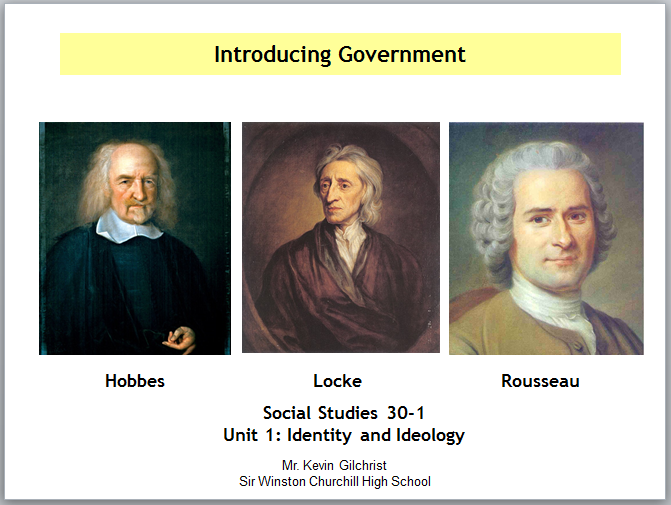
  • please print off (4 slides per page) of the following Unit 1 PowerPoint presentations: "Identity and Ideology" and "Introducing Government" (I'll go over this one in class on Thursday, May 19th)
  • you should read, highlight and annotate both of these presentations


(I'll go over Introducing Government in class on Thursday)


  • by Friday, May 20th you should be ready to go through the Unit 1 Review Prezi on the IB 30/35 wiki. 
  • scroll down on the navigation menu on the right-hand side of the wiki to find the Social 30-1 section to find all of the notes and PowerPoint presentations


Since we'd talked about the issue of resource development last week, I thought that it would be prudent to show you a video from the HBO series "Vice" and episode called "The Resource Curse" which examined a case study of an Exxon Mobil liquefied natural gas (LNG) project in Papau New Guinea, among others. I'm embedding this episode below.


In connection with watching "Shipbreakers" last week, and talking about the life cycle of a ship and the sustainability of the shipbreaking industry, I thought it would be interesting to look at another example of an industry that has environmental consequences that are sort of "out of sight, out of mind". I'm talking about e-waste. National Geographic Magazine had a feature on e-waste in their January 2008 issue that I would like you to read. Here is the hyperlink to the article: click here. I also showed you a short video on e-waste in China from the CBC News in Review. As you watched this video you should answered the video review questions. I gave you a copy of the Unit 4 Worksheet today as well. The Chapter 15 Key Terms and Questions are due next week on Wednesday, May 25th.

Please have a look at the upcoming important dates for Social 10-1 students: 

  • Unit 3 WRA II Essay is on Wednesday, May 18th (please look at the sample student essays on the Social 10-1 wiki)
  • Unit 3 Final Exam (the study guide goes up tomorrow on the blog)
  • Chapter 15-16 Test is on Thursday, June 2nd
  • Social 10-1 Final Exam Part A is on Wednesday, June 8th


We continued topics that we started last week, namely illiberalism (you can also use the Civil Rights Movement as a case study for undemocratic actions/illiberalism) and the usage of the War Measures Act. This legislation was only to be used in circumstances of war, invasion and insurrection. In Social 20-1, you should have discussed the treatment of "enemy aliens" in WWI, and the internment of Japanese-Canadians during WWII. Today, we covered the FLQ crisis of 1970 in which Quebec Premier Robert Bourassa called in Canadian Forces claiming that the Quebec provincial government was facing an "apprehended insurrection". We watched a video from the Turning Points of History on the FLQ Crisis. As you watched this video, you should have filled in the blanks for the film study sheet in your Social 30-1 booklets.

I also did a homework check on Chapter 9 Key Terms and Questions, and the Civil Rights Movement Assignment at the beginning of class. Your Chapter 11 Key Terms and Questions are due tomorrow. You're writing your Unit 3 WRA I (if you're in 30-1) on Thursday. Social 30-2 students will be writing an Assignment 3 (three citizens question).


Monday, December 07, 2015

December 7


We covered the usage of the War Measures Act during the FLQ Crisis in 1970 in Quebec today. I showed you a video from the Turning Points of History series on the FLQ Crisis, and while you were watching this video, you needed to complete the film study questions in your Social 30-1 study booklets (pages 248-249). Please remember the following upcoming important dates:
  • USA-Canada Comparative Government Assignment is due tomorrow.
  • Chapter 9 Key Terms and Questions are due on Wednesday, December 9th
  • US Civil Rights Movement Assignment is due on Thursday, December 10th


We covered a lot of ground today with market and mixed economies, all in preparation for your Market and Mixed Economy Test which is on Wednesday, December 16th. I will post the study guide for this test on Wednesday (December 9th).


We looked at the controversy surrounding biofuels today, and we talked about measures of prosperity in the "Globalization and Sustainability" PowerPoint presentation. As I said in class, the Millennium Development Goals have hit their expiration date, and the UN has negotiated a new framework for development called the Sustainable Development Goals, or more simply put, the Global Goals. You are responsible for going through any material that I may have skipped over in this lecture. Please remember the following upcoming important dates:
  • Unit 3 WRA II Essay is on Thursday, December 10th
  • TNC Dossier Assignment is due on Friday, December 11th
  • Unit 3 Final Exam is on Monday, December 14th (see study guide below)

Please make sure that you have read Chapters 10-14. Please make sure that you have the following PowerPoint presentations, and that you study from them:

  • "Foundations of Economic Globalization"
  • "The Expansion of Economic Globalization"
  • "Challenges and Opportunities of Economic Globalization"
  • "The Impact of Economic Globalization on Environments"
  • "Globalization and Sustainability"
Make sure that you have reviewed the Key Terms from Unit 3 (all the terms listed on the Unit 3 Worksheet, plus the extra key terms that appeared in the PowerPoint presentations). The Unit 3 Final Exam will consist of 50+ multiple choice questions.

Friday, July 24, 2015

July 24


You wrote your Chapter 10 Test today, and I did a homework check on the Chapter 10 Key Terms and Questions. I gave you some notes on liberalism, illiberalism and the War Measures Act. The three situations in which the Canadian government could you use was war, invasion and insurrection. The War Measures Act was used three times in Canadian history: World War I (1914-1918), which led to the internment of so-called "enemy aliens". The War Measures Act is also used during World War II (1939-1945) to intern Japanese-Canadians in response to the Japanese surprise attack on Pearl Harbor on December 7, 1941. The Canadian federal government also uses the War Measures Act in October 1970 during the FLQ Crisis, with the Quebec government claiming that they were facing an "apprehended insurrection". As you watched today's video from the Turning Points in History series, you were to complete the film study fill in the blanks. In today's video we looked at the FLQ crisis, this is the interview on the steps of Parliament that features Trudeau's "just watch me" speech. It's an interesting little debate that is waged being Trudeau and the reporters over the issue on giving up or losing civil liberties in order to ensure security.


  • Unit 3 WRA I is on Monday, July 27th
  • USA-Canada Comparative Government Assignment is due on July 27th
  • Chapter 9 Key Terms are due on July 27th
  • Unit 3 Final Exam is on Tuesday, July 28th (please see the study guide below)
  • U.S. Civil Rights Movement Assignment (questions 1-14) is due onTuesday, July 28th
  • Chapter 11 Key Terms and Questions are due on July 28th
  • Chapter 12 Key Terms and Questions are due on Wednesday, July 29th
  • Social Studies 30-1 Trial Final Exam is on Thursday, July 30th (last day of classes)


Your Unit 3 Final Exam will be on Tuesday, July 28th. 
Please study the following material: 
  • make sure that you have read Chapters 9-12 in Perspectives on Ideology
  • study all key concepts from the Chapters 9-12 Worksheets (see below)
  • study all questions/answers from the Chapters 9-12 Worksheets
  • "Political Challenges to Liberalism" (PowerPoint presentation)
Review the following notes/packages:
  • Democratic Systems
  • Non-Democratic Systems
  • types of dictatorships
  • techniques of dictatorships
  • Civil Rights Movement
  • authoritarian systems (China notes)
  • review the economic and political spectrum (again!)
  • re-read the notes on rights that I put on the board (Charter of Rights and Freedoms to War Measures Act)
  • FLQ Crisis 1970
Know the following key concepts/key events/key terms/key people:
  • assimilation
  • self-interest
  • humanitarianism
  • Indian Act
  • residential school system
  • enfranchisement
  • the White Paper
  • the Red Paper
  • “war on terror"
  • authoritarianism
  • consensus decision-making
  • direct democracy
  • military dictatorship
  • oligarchy
  • one-party state
  • party solidarity
  • representation by population
  • proportional representation
  • representative democracy
  • responsible government
  • democracy
  • single-member constituency (first past the post)
  • the Senate
  • the House of Commons
  • the House of Representatives
  • the Senate
  • mixed-member proportional system
  • lobby groups
  • American Bill of Rights
  • Anti-Terrorism Act
  • Canadian Charter of Rights and Freedoms
  • emergency and security legislation
  • illiberal
  • language legislation
  • Bill 101
  • Bill 178
  • Bill 86
  • Quebec Charter of Human Rights and Freedoms
  • respect for law and order
  • terrorism
  • rendition
  • the War Measures Act
  • enemy aliens
  • internment
  • the Emergencies Act
  • USA PATRIOT Act
  • consumerism
  • environmental change
  • extremism
  • pandemics
  • postmodernism
  • global warming
  • Kyoto Protocol
  • World Health Organization (WHO)
  • drought

Monday, June 09, 2014

June 9


We covered a new topic in the Social 30-1 course today with the FLQ Crisis. I showed you a video from the Turning Points of History on the FLQ Crisis of 1970. We'd already talked about illiberalism and the War Measures Act, but this crisis was the third usage of the War Measures Act. Remember, the War Measures Act could only be used during times of "war, invasion or insurrection", and according to Robert Bourassa's government, the government of Quebec was facing an "apprehended insurrection". If you missed class today, please make sure that you pick up the booklet and get the notes from a classmate. Please remember the you have your Trial Final tomorrow. Please use the Social 30-1 Diploma Exam Review Booklet as your study guide. We'll have a year-end party on Wednesday, please bring food and drinks!


I gave you back the results of Part A of your Final Exam today. I also gave you your assigned seat for the exam. We finished watching "Contagion" today.


We continued our examination of democratic systems today, specifically the Canadian political system. I showed you part of the "Understanding Canadian Government" video as well. I also gave you your assigned seat for the final exam too.

Wednesday, December 11, 2013

December 11


I gave you back your Unit 2 WRA II Essays today. I also gave you back your Unit 2 Research Projects as well. Now that everyone has written the Unit 2 Final Exam, you'll get the results of this exam tomorrow. I started a PowerPoint presentation today that I'll finish off tomorrow called "Internationalism and Nationalism". You will be writing your Unit 3 WRA II Essay on Tuesday, December 17th, and you'll get the essay question sheet on Friday.

We finished off the FLQ Crisis video. I gave you a couple of handouts on how to write an analysis of propaganda posters. You'll be writing an analysis of a propaganda poster tomorrow. We'll continue looking at illiberalism this week by talking about the changes to the world caused by 9/11. Please remember that you have your Unit 3 WRA II Essay on Monday, December 16th.

I tied up some loose ends today with supply side economics and how demand-side and supply-side deals with a recession. Please remember that you have your Social 30-1 Market and Mixed Economy Test tomorrow, please check out the study guide here (scroll down to find it).

Wednesday, May 22, 2013

May 22


We finished off the FLQ Crisis video from the History's Turning Points series today. We started to develop an understanding of historical context by examining the 9/11 attacks. In order to understand the mood in the United States after 9/11 and be able to provide a rationale for why they pushed through the USA PATRIOT Act so quickly you need this context. Make sure that complete all of the video questions from the CBC News in Review booklet that I gave you as well as read all of the articles in that booklet as well. Please check your e-mail tonight for notes on the Patriot Act and the Anti-Terrorism Act. Please print these notes off, read them, highlight them and annotate them prior to tomorrow's class. Your Chapter 10 Test is on Monday, please see the study guide below.


This test is multiple choice format, with 55 questions. Please review the PowerPoint "Political Challenges to Liberalism". You're responsible for all key terms and questions from the Chapter 10 Worksheet. Please review the following as well:
  • Democratic Systems (handout notes)
  • Non-Democratic Systems (handout notes)
  • Structure of Canadian Government
  • Structure of American Government
  • similarities/differences between the parliamentary system and presidential system
  • types of dictatorships
  • techniques of dictatorships
  • authoritarian systems
  • proportional representation concept
  • first past the post system
  • review political and economic spectrum (again!)


You had most of the class period to work on a foreign policy booklet that required you to define key terms and concepts, and to provide examples of these key concepts. I will do a homework check on this booklet on Friday. You should have completed this work in class. You also had some time to do some group brainstorming on arguments and evidence for tomorrow's Unit 3 WRA II Essay. Don't be late tomorrow, since we're writing this essay right at the beginning of the day in the Blenheim lab.
 
We did a lot of review today in preparation for tomorrow's written test. I reviewed the 19th century political spectrum, the 20th century political spectrum, the principles of individualism (PRICES) and the principles of collectivism (PRINCE), the economic-political grid and the techniques of dictatorship. All of these concepts were taught to you in Grade 11, but we needed to review these concepts. You are writing your Unit 1 Final Exam on Friday, please see the study guide below. You have your Economic Systems Exam on Wednesday, May 29th, this exam deals with the market economy, the mixed economy, and the command economy. In the first semester you wrote an exam that covered the market and mixed economy, so it expands on those concepts. You can find the study guide below.


The Unit 1 Final is a 55 question multiple choice test. It will be written on Friday, May 24th. Make sure that you study the following:
  • Study the principles of individualism (PRICES) and principles of collectivism (PRINCE)
  • Study the Ideology Notes (Black Gold School District PDF file)
  • Study the 19th Century Political Spectrum
  • Study the 20th Century Political spectrum
  • Study the political-economic grid
  • Know the values and ideas associated with the various ideologies (on the 19th century and 20th century spectrums)
  • Study the Individualism and Collectivism booklet
  • review your Enlightenment philosophers that you were introduced to previously: Hobbes, Locke, Rousseau

This is a comprehensive exam that covers all of the major economic systems: market economy, mixed economy, and command economy. It is 70 multiple choice questions. This exam will be administered on Wednesday, May 29th.
     
  • study all of the following PowerPoint presentations that are on the wiki for Unit 2:
                   - The Development of Classical Liberalism
                   - Responding to Classical Liberalism
                   - The Evolution of Modern Liberalism
                   - 20th Century Rejections of Liberalism
  • focus on the Soviet Union, and left-wing of economic spectrum (command economy), we haven't covered aspects of dictatorships or Nazism yet (the techniques of dictatorship and fascism will be on a Chapter 5 Test)
  • please see the summary notes from the Ideologies textbook: Chapter 7 (Private Enterprise) from the wiki 
  • supply-side economics
  • boom and bust cycle/business cycle
  • laws of supply and demand, Adam Smith, invisible hand, market forces
    self-interest, consumer sovereignty, competition, private ownership, profit motive
  • basic economic problems/questions
  • advantages/disadvantages of the market economy
  • causes of the Great Depression
  • FDR and the New Deal
  • please see summary notes from the Ideologies textbook on the Mixed Economy Case Studies #14 (Sweden) and #15 (Canada), #16 (Japan), #17 (Fascism and Nazism)
  • also see the Democratic Socialism booklet on Sweden (indicative planning, "cradle to the grave" economics)
  • characteristics of a mixed economy
  • nationalization
  • privatization
  • democratic socialism
  • welfare capitalism
  • Keynesian economics
  • the business cycle and fiscal and monetary policies (study all of the notes I gave you and the booklet that is on the wiki)
  • demand-side economics
  • neo-conservatives
  • monetarism
  • trickle down economics
  • supply-side economics
  • Thatcherism and Reaganomics
  • Milton Friedman
  • Friedrich Hayek
  • how Keynesian economics deals with a recession (remember "the percolator": increase circulation of money reducing taxes, increase government spending on "make work" projects, and reduce interest rates, which according to Keynesian economics is going increase demand for goods and services and lead to more money circulating in the economy)
  • how supply-side economics deals with a recession (remember "trickle down coffee maker": government should stimulate the goods and services sector of the economy by reducing corporate and personal taxes, eventually benefits will "trickle down" to the middle class and working class, make connections between supply-side economics and laissez faire economics/classical liberalism)
  • advantages and disadvantages of a mixed economy
  • neo-conservative criticism of government intervention
  • characteristics of a centrally planned economy
  • advantages and disadvantages of a centrally planned economy
  • Marx notes
  • Lenin notes
  • establishment of the Soviet Union
  • Soviet economic system (top-down decision-making process)
  • Lenin's War Communism and the New Economic Policy
  • Stalin notes 
  • "Changes to Soviet Society After Stalin" notes (this bridges the gap between Stalin and Gorbachev)
  • Gorbachev to Collapse Notes