Hi everyone. I will be posting information about homework, assignments, projects, and upcoming quizzes and tests on this blog. Please check the site on a regular basis to keep up to date. To my current students, if you have any questions, please feel free to send me an e-mail or post a comment. If there are any teachers that have any requests or questions, or if you want an invitation to the Alberta Social Studies Ning, please find my contact information under "View My Complete Profile".
We finished off the "Road to World War II: Germany" today. I then started a lecture on "The International Response to German Aggression, 1933-1940", which I should be able to finish up. We'll be looking at appeasement in greater detail in the next couple of days. Don't forget to complete the Google Doc assignment (it was due today).
Social 10-1
I had you read a short article from the CBC News in Review series on e-waste in China. When I showed you this video, you were supposed to answer the fill in the blanks activity that went with the video. I then delivered a little bit more of the "Globalization and Sustainability" lecture today. I'll finish off this lecture tomorrow. Your TNC Dossier Assignment is now due on Thursday, December 7th. Everyone gets an extension!
You wrote your Unit 2 Final Exam today, and you'll get the results back tomorrow. I also returned your marked Unit 2 WRA II Essays today. We'll continue with Unit 3 material tomorrow. Your Chapter 9 Key Terms and Questions are due tomorrow.
Social 10-1
I showed you a video today from an old TV show called "The Hour" that was hosted by George Stroumboulopoulos. In the part of the episode that I showed you George Stroumboulopoulos was interviewing Jeff Rubin, the former chief economist at CIBC. Jeff Rubin was discussing the sustainability of globalization if transportation costs increased due to increased oil prices. Rubin was doing press interviews in support of his book "Why Your World is About to Get a Whole Lot Smaller". In connection with watching "Shipbreakers" last week I thought it would be interesting to look at another example of an industry that has environmental consequences that are sort of "out of sight, out of mind". I'm talking about e-waste. We discussed possible solutions to the problem as well. Here's a link to an article on e-waste in China: http://www.cnn.com/2013/05/30/world/asia/china-electronic-waste-e-waste/ Here's another article (from just 4 months ago): https://www.theguardian.com/environment/2017/jan/16/chinas-booming-middle-class-drives-asias-toxic-e-waste-mountains
I started Social 30-1 material today, so if you missed class today, you'll have some catching up to do this week. I gave everyone who came to class a Social 30-1 workbook for IB History students, that is yours to keep.
I reviewed the following content today:
19th century political spectrum (and their view on change; along with some quick review of the French Revolution and the Napoleonic era, specifically the Congress of Vienna)
20th century political spectrum (I also talked about classical liberalism = economic conservatism, modern liberalism, and the transition from classical liberalism to welfare capitalism to modern liberalism--which created the welfare state. Remember: welfare capitalism is synonymous with welfare state)
economic spectrum
the techniques of dictatorship
economic-political grid (democratic socialism, democratic capitalism, dictatorial socialism and dictatorial capitalism, plus examples of each)
economic values of a command economy, a mixed economy and a market economy
principles of individualism (PRICES) --remember principles of individualism = principles of liberalism (I also defined liberalism)
principles of collectivism (PRINCE)
Here is your homework assignment between now and when I see you next on May 19th:
read, highlight, annotate the Ideology Notes in the Social 30-1 workbook (pages 5-10)
read, highlight and complete the individualism and collectivism charts on pages 11-15
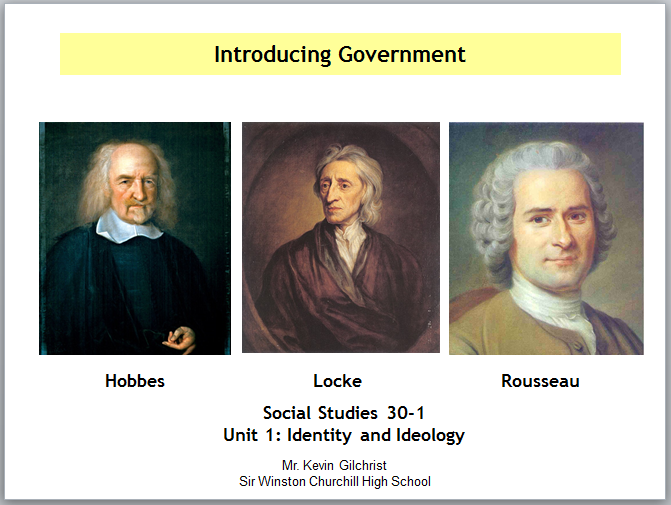
please print off (4 slides per page) of the following Unit 1 PowerPoint presentations: "Identity and Ideology" and "Introducing Government" (I'll go over this one in class on Thursday, May 19th)
you should read, highlight and annotate both of these presentations
(I'll go over Introducing Government in class on Thursday)
by Friday, May 20th you should be ready to go through the Unit 1 Review Prezi on the IB 30/35 wiki.
scroll down on the navigation menu on the right-hand side of the wiki to find the Social 30-1 section to find all of the notes and PowerPoint presentations
Social 10-1
Since we'd talked about the issue of resource development last week, I thought that it would be prudent to show you a video from the HBO series "Vice" and episode called "The Resource Curse" which examined a case study of an Exxon Mobil liquefied natural gas (LNG) project in Papau New Guinea, among others. I'm embedding this episode below.
In connection with watching "Shipbreakers" last week, and talking about the life cycle of a ship and the sustainability of the shipbreaking industry, I thought it would be interesting to look at another example of an industry that has environmental consequences that are sort of "out of sight, out of mind". I'm talking about e-waste. National Geographic Magazine had a feature on e-waste in their January 2008 issue that I would like you to read. Here is the hyperlink to the article: click here. I also showed you a short video on e-waste in China from the CBC News in Review. As you watched this video you should answered the video review questions. I gave you a copy of the Unit 4 Worksheet today as well. The Chapter 15 Key Terms and Questions are due next week on Wednesday, May 25th.
Please have a look at the upcoming important dates for Social 10-1 students:
Unit 3 WRA II Essay is on Wednesday, May 18th (please look at the sample student essays on the Social 10-1 wiki)
Unit 3 Final Exam (the study guide goes up tomorrow on the blog)
Chapter 15-16 Test is on Thursday, June 2nd
Social 10-1 Final Exam Part A is on Wednesday, June 8th
Social 30-1
We continued topics that we started last week, namely illiberalism (you can also use the Civil Rights Movement as a case study for undemocratic actions/illiberalism) and the usage of the War Measures Act. This legislation was only to be used in circumstances of war, invasion and insurrection. In Social 20-1, you should have discussed the treatment of "enemy aliens" in WWI, and the internment of Japanese-Canadians during WWII. Today, we covered the FLQ crisis of 1970 in which Quebec Premier Robert Bourassa called in Canadian Forces claiming that the Quebec provincial government was facing an "apprehended insurrection". We watched a video from the Turning Points of History on the FLQ Crisis. As you watched this video, you should have filled in the blanks for the film study sheet in your Social 30-1 booklets.
I also did a homework check on Chapter 9 Key Terms and Questions, and the Civil Rights Movement Assignment at the beginning of class. Your Chapter 11 Key Terms and Questions are due tomorrow. You're writing your Unit 3 WRA I (if you're in 30-1) on Thursday. Social 30-2 students will be writing an Assignment 3 (three citizens question).
We continued examining the mixed economy today. I went through a detailed handout on monetary and fiscal policy. I gave you a booklet on democratic socialism and the mixed economy. I also showed you a couple of videos from the 60 Minutes TV newsmagazine show, one called "Dutch Treat" and "Welfare a la carte". We'll begin looking at the command economy tomorrow.
Social 30-1
In order to understand post-9/11 anti-terrorism legislation I needed to give you some historical context. I showed you a video from the Smithsonian TV channel called "9/11: The Day that Changed the World". We'll finish this video off tomorrow, and start looking at the USA PATRIOT Act. I also collected your USA-Canada Comparative Government Assignment.
Please remember the following upcoming important dates:
Chapter 9 Key Terms and Questions are due on Wednesday, December 9th
US Civil Rights Movement Assignment is due on Thursday, December 10th
Social 10-1
In connection with watching "Shipbreakers" last week, and talking about the life cycle of a ship and the sustainability of the shipbreaking industry, I thought it would be interesting to look at another example of an industry that has environmental consequences that are sort of "out of sight, out of mind". I'm talking about e-waste. We watched a short excerpt from the CBC News in Review on "Electronic Waste and China". Here is a link to an article that was in National Geographic Magazine in their January 2008 issue that I would like you to read. Here is the hyperlink to the article: click here. We also started to look at the Unit 3 WRA II Essay question sheet. We'll be working on a Google Doc tomorrow and collectively write an essay outline.
Please remember the following upcoming important dates:
Unit 3 WRA II Essay is on Thursday, December 10th
TNC Dossier Assignment is due on Friday, December 11th
Unit 3 Final Exam is on Monday, December 14th (see study guide below)
UNIT 3 FINAL EXAM STUDY GUIDE:
Please make sure that you have read Chapters 10-14. Please make sure that you have the following PowerPoint presentations, and that you study from them:
"Foundations of Economic Globalization"
"The Expansion of Economic Globalization"
"Challenges and Opportunities of Economic Globalization"
"The Impact of Economic Globalization on Environments"
"Globalization and Sustainability"
Make sure that you have reviewed the Key Terms from Unit 3 (all the terms listed on the Unit 3 Worksheet, plus the extra key terms that appeared in the PowerPoint presentations). The Unit 3 Final Exam will consist of 60+ multiple choice questions.