If you missed class today you missed notes on the Canadian Bill of Rights, the Charter of Rights and Freedoms, civil rights, entrenchment of rights, UN Universal Declaration of Human Rights, and the War Measures Act. Please get these notes from a classmate. I also had you do an exercise on the
Charter of Rights and Freedoms, which I did a class check on. Your
Chapter 17 Key Terms and Questions are due on Monday. See you Monday! Enjoy your long weekend!
I showed you Part 1 of the A & E Biography of Hitler called
"The Fatal Attraction of Adolf Hitler". You should be reading and studying the
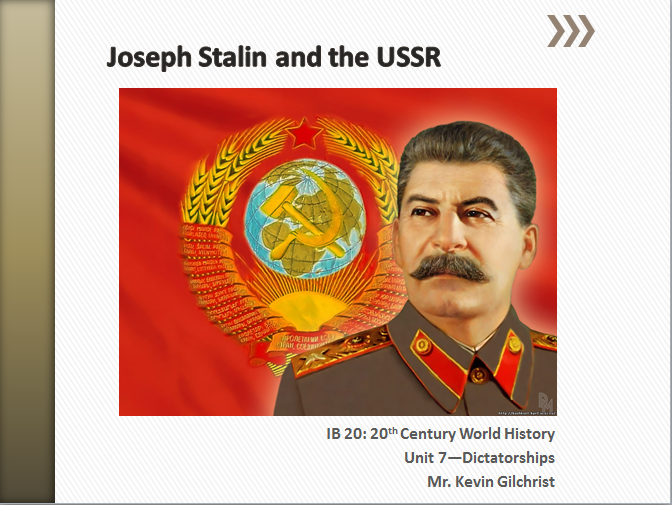
"Joseph Stalin and the USSR" PowerPoint, and the
Hitler Paper 2 Review PowerPoint this long weekend. You will be writing a
Paper 2 Topic 3 on the Origin and Development of Authoritarian and Single Party States on Thursday, June 5th.
I'm going to give you a little
advice for writing your Paper 2 on Thursday. Some of this advice applies to the actual
Paper 2 Exam that you will be writing in May 2015.
The actual Paper 2 Exam consists of five topics, you'll deal with three of them in Grade 11 and 12. The topics that we cover are
Topic 1: Causes, Practices and Effects of War, T
opic 3: Authoritarian and Single-Party States, and
Topic 5: The Cold War. You'll deal with Topic 1 and Topic 5 next year.
The Paper 2 that you write on Thursday deals only with Authoritarian and Single-Party States. On the actual Paper 2 Exam, each of the five topics will have six questions, and you will have to answer two of them.
For Thursday's Paper 2 you just have to answer one of the questions.
- For each topic on the Paper 2 Exam, three out of the six questions will be 'named' questions. This means that in Topic 3, three of the questions will refer to particular states or leaders. (ex. Analyze the methods used by either Castro or Mao to maintain his position as the ruler of a single-party state.)
- For each topic on the Paper 2 Exam, two out of the six will be 'open-ended' or general questions. This means you can choose any suitable example that you have studied. (ex. Examine how and why one leader of a single-party state was able to make a successful bid for power.)
- For each topic on the Paper 2 Exam, one out of the six will ask about 'social, economic or gender issues'. (ex. Discuss the role and status of women in two single-party states, each chosen from a different region.)
Make sure that you
know what your IB command terms mean (ex.
analyze, compare and contrast, discuss, evaluate, examine, to what extent).
For the upcoming Paper 2 on Thursday, make sure that you
review Hitler and Stalin.
The themes that you should study for Topic 3 are as follows:
Origins and nature of authoritarian and single-party states
This theme asks you to look at the rise to power of authoritarian and single-party state leaders or the emergence of authoritarian or single-party states. You need to consider what kind of circumstances made it possible for this to happen and what kinds of methods were used by the leader to take power.
Establishment of authoritarian and single-party states
This theme asks you to look at the leader or the state once power has been assumed and other political parties or groups have been suppressed. You need to consider how power is maintained, probably through the use of popular policies and/or terror.
Domestic policies and impact
This theme asks you to look at the way the state is actually structured and what kind of policies are carried out. You need to consider what kind of programme is put into practice and how economic and social policies are created and implemented. You will also need to know something about the role of women, attitudes towards religion and the kind of culture that developed inside the state.
Other pieces of advice:
- choose your question carefully
- on the actual Paper 2 Exam, you'll only have about 45 minutes to write each answer (remember you answer two questions for a 90 minute exam)
- make sure that you do a quick plan for your essay (if it's a compare and contrast question, set up a chart with similarities that two leaders had in common, and their differences in the other column)
Do's:
- Do read the question very carefully and make sure that you can answer it. If a specific time period is mentioned, do you have enough material to cover it all? If the question asks about social and economic policies, do you know enough about both?
- Do answer the question that is asked on the exam paper and not a similar one you prepared earlier!
- Do plan your answer and include this plan on your exam answer sheets.
- Do begin with an introduction and always refer to the question in the introduction.
- Do define any key words such as 'totalitarian' or 'authoritarian' if the question mentions these.
- Do use a comparative structure if the question asks you to compare and contrast.
- Do include DATES! When you are writing about why something happens, you will usually need to refer to what came before (cause and effect), and so knowing the order in which events happen is very important.
- Do refer to the question in each paragraph, to make sure that your answer stays focused.
- Do finish with a conclusion that sums up your arguments.
- Do include some reference to different historical interpretations, if this is appropriate.
Don'ts:
- Don't write down everything you know about a topic; you need to select only relevant material.
- Don't leave out facts and dates. Your arguments need to be supported, so saying that Castro used guerrilla tactics to come to power is fine, but you need to support this statement with evidence of how he did this.
- Don't just list what historians say about a topic; use historiography to support your arguments not replace them.
- Don't use quotations to replace your arguments. If you use quotations, explain why and link them to your arguments.
- Don't use 'I think ... ' or 'In my opinion ... ' but instead write, 'It is clear that..,' or 'Given the evidence. it can be seen that., .' Try to keep an 'academic' tone to your writing.
Introductions and conclusions - don't neglect these!
Introduction
There is no formula for a good introduction. While some students will state very clearly how they will structure their answers, others may simply give some relevant background and their thoughts on the question. Examiners will want to know that you have understood the question and have grasped its implications. Think of it as a 'first impression', leading the examiner to think 'Good, they are on the right track'. Also, if you are answering an 'openended' question that may, for example, ask about the rise to power of a leader, then you can state here what time period you will focus on. In the case of Nasser, for instance. would you begin in 1952 or 1948 or earlier? Also, are there terms that need to be defined? If so, it is a good idea to do this in the introduction.
Conclusion
Here is your chance to make a 'lasting impression'. You will need to summarize your arguments concisely, but not by repeating them one by one, this is tedious add much to the answer. If you have a nice quotation that is relevant (make sure it is!) and sums up your argument, then use it in the conclusion. It may spark the marker's interest and leave a good impression.
I lectured from the
"Responding to Classical Liberalism" PowerPoint today. I also briefly talked about the boom and bust cycle, Keynesian economics and economic systems. Please make sure that you are ready for the
Economic Systems Exam on Monday, June 2nd,
please see the study guide here.