Showing posts with label the Korean War. Show all posts

Friday, February 16, 2018

February 16

Sorry, it looks like I forgot to post on Wednesday. Here's what happened in class:


For most of the class we talked about media consolidation and the big 6 media TNCs that produce 90% of the content that you consume. If you missed class today, make sure that you get the "Media Giants and Me" notes from a classmate. Please don't forget that your universalization and hybridization assignment is due on Wednesday, February 21st. Please see the notes below on how to cite the images that you use in your project. Also, don't forget that you have your Chapter 1-2 Test on Thursday, February 22nd, the study guide is posted below.


Most of you will probably use Google for your image search. Just type in your image search term. I typed in The Holocaust. 
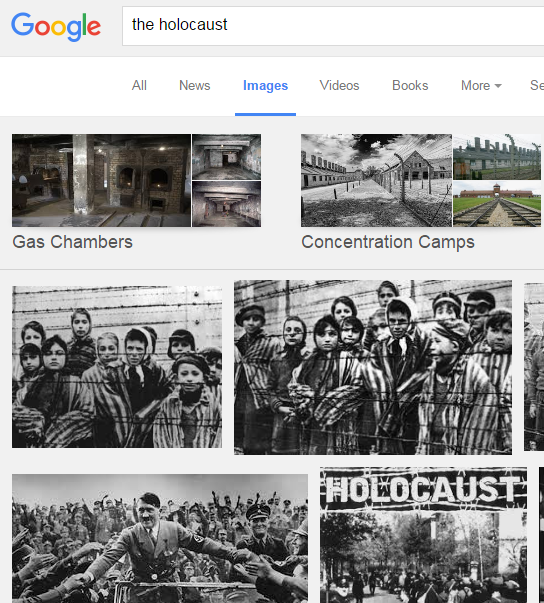


A bunch of different images will pop up. Just click on one that you like. I clicked on the first image and a pop-up screen will show you the image more closely. 


Click on "View Image". In the address bar you will see a specific URL for the image. This is what you need for your image citation. It should end in either .jpg or .png. or .svg or some other file extension that indicates that it is an image file. 


If you're working in Microsoft Word, click on the References tab. You can select the Style of citation here (MLA, Chicago, APA, etc.). If you need to insert an in-text citation, you click on Insert Citation. If you want to start building a Bibliography, you can Insert Citation or Manage Sources.


You'll get a pop-up dialogue box like the one pictured below. I filled in the fields for the image that I picked. There are also online citation machines available as well, such as EasyBib (http://www.easybib.com/)


  1. Study your Chapter 1 and 2 Key Terms
  2. Review the case studies from the textbook in Chapters 1 and 2, specifically the Metis, the Francophones, the Hmong, and the Maori
  3. Be prepared to answer any of the "Questions for Inquiry" from Chapters 1 and 2 (they are on the following pages: p.9, p.14, p.20, p.29, p.35, p.39):
  • How does globalization affect economic aspects of people's lives?
  • How does globalization affect social aspects of people's lives?
  • How does globalization affect political aspects of people's lives?
  • What is the difference between individual and collective identity?
  • What is the relationship between identity and language?
  • How does cultural exchange shape people's identities?
4. Make sure that you can answer all of the chapter questions from the Unit 1 Worksheet


I off the lecture on the Napoleonic Age and showed you a video on Napoleon's invasion of Russia today as well. I will teach you the 19th century political spectrum on Tuesday. Don't forget that you're writing the Chapter 1-2 Test on Wednesday. Please check out the Chapter 1-2 Test Study Guide below. 

You should also have a look at this timeline of key events in Napoleon's life that I made a few years ago on Timetoast: http://www.timetoast.com/timelines/3805

You could also check out this one that I made on the key events of the French Revolution: http://www.timetoast.com/timelines/3780

For both of these timelines, click on the slider button and drag it to advance through the years. 

This test will be on Wednesday, February 21st. The test has a matching section and ashort answer section.
  • Make sure that you have read both Chapter 1-2 from your textbook Exploring Nationalism
  • Study Chapter 1-2 Key Terms from the Unit 1 Worksheet
  • Study your answers to the questions from the Unit 1 Worksheet for Chapter 1-2

Study the following PowerPoint presentations:

  • "Nation and Identity" (Chapter 1 material + supplementary material)
  • "Shaping Nationalism: The French Revolution" (Chapter 2 material + supplementary material; key terms from the French Revolution and Napoleonic Age Glossary of Key Terms)
  • "The Napoleonic Age" (Chapter 2 material + supplementary material; key terms from the French Revolution and Napoleonic Age Glossary of Key Terms)


I showed you a video from the History's Turning Points series on the Korean War. Please check your Google Drive for notes on the Korean War that I shared with you. Please print these notes out, read them, highlight them, and annotate them as well, then add them to your notebooks. I then started talking about the Truman administration. I'll be sharing the Truman administration lecture with you on Google Drive.

Thursday, February 18, 2016

February 18


We covered a lot of territory today in class, since we looked at the Truman administration (foreign and domestic policy), with a little bit of overlap in the Korean War between the Truman and Eisenhower administration. We also looked at the Korean War (1950-1953) again by watching a short video called "Crisis in Korea". I gave you a one page handout on the Korean War, and I STRONGLY recommend that you check out the Korean War notes on the wiki on the Cold War page. Also, check out the historiography on the Korean War, and on the origins of the Cold War itself (also on the same wiki page). Please remember that next Friday (February 26th) that you have a Paper 2 on the origins of the Cold War. Start preparing for this!

Also, don't forget that TOK presentations, and the Greatest Canadian Prime Minister of the 20th Century presentations will run on February 23rd-25th.


You wrote your Unit 1 WRA II Essay in class today. It usually takes me a couple of weeks to mark a class set of essays, so please be patient.


I gave you time to work on your Chapter 3 Key Terms and Questions today in class, since it seemed like you needed it. These key terms and questions are due tomorrow. Your Chapter 4 Key Terms and Questions are due on Monday, February 22nd. You are writing your Chapter 1-2 Test on Tuesday, February 23rd (please see the study guide below).

Don't forget that your Illustrated Concept Map is due on February 29th.


  1. Study your Chapter 1 and 2 Key Terms
  2. Review the case studies from the textbook in Chapters 1 and 2, specifically the Metis, the Francophones, the Hmong, and the Maori
  3. Be prepared to answer any of the "Questions for Inquiry" from Chapters 1 and 2 (they are on the following pages: p.9, p.14, p.20, p.29, p.35, p.39):
  • How does globalization affect economic aspects of people's lives?
  • How does globalization affect social aspects of people's lives?
  • How does globalization affect political aspects of people's lives?
  • What is the difference between individual and collective identity?
  • What is the relationship between identity and language?
  • How does cultural exchange shape people's identities?
4. Make sure that you can answer the questions from the Unit 1 Worksheet for these chapters.


Thursday, November 05, 2015

November 5


We looked a little more at "The League of Nations" PowerPoint presentation. We started the film "Paris 1919", you should be able to finish this film off tomorrow. Please remember that you have your World War I Test on Monday. Next Friday (November 13th) you will write a Social Studies 30-1 WRA I (three source analysis) on WWI.


We covered a couple of topics today: the Korean War and the Cuban Missile Crisis. I showed you two documentaries, one from the Turning Points of History series called "Crisis in Korea". The other documentary was from the BBC 20th Century History series called "Mr. Kennedy and Mr. Khrushchev". Please make sure that have read the sections on the Korean War and the Cuban Missile Crisis from your Social 30-1 study booklets. Your Chapter 7 Questions are due tomorrow.


We finished off the China Rises "Getting Rich" video today. The rest of the class period you were split into your debate groups so that you can plan out for tomorrow's debate. Remember the debate topic is BIRT the 21st Century will belong to China. Please remember that you have your Unit 2 Final Exam on Monday, please see the study guide below.


This final exam is entirely multiple choice format. There are 57 multiple choice questions. This Unit 2 Final Exam will be on Monday, November 9th. Please make sure that you study your key terms from Unit 2 (Chapters 6-9), as well as the three PowerPoint presentations from this unit:
  • "Historical Globalization and Imperialism"
  • "Legacies of Historical Globalization"
  • "Legacies of Historical Globalization in Canada"

Key Concepts from Unit 2:
  • world views
  • historical globalization
  • cultural contact
  • depopulation
  • the Silk Road
  • international trade
  • mercantilism
  • capitalism
  • free market
  • entrepreneurs
  • Adam Smith
  • exploitation
  • communism
  • industrialization
  • Industrial Revolution
  • cottage industries
  • imperialism
  • "new" imperialism
  • "old" imperialism
  • colony
  • protectorate
  • sphere of influence
  • paternalistic
  • Confederation
  • residential schools
  • the Oka crisis
  • First Nations Policing Policy
  • legacy
  • ethnocentrism
  • Eurocentrism
  • Scramble for Africa
  • Leopold II
  • migration
  • displacement
  • British East India Company
  • Queen Elizabeth I
  • the Raj
  • Mohandas Gandhi
  • swadeshi
  • deindustrialization
  • colonization
  • the Hundred Associates
  • Hudson’s Bay Company
  • Rupert’s Land
  • North West Company
  • Seven Years’ War
  • Proclamation of 1763
  • Quebec Act of 1774
  • the Numbered Treaties
  • the Indian Act
  • Status Indian
  • Non-Status Indian
  • multiculturalism
  • specific claims
  • comprehensive claims

Monday, November 03, 2014

November 3


I gave you back your Unit 1 WRA I today. I didn't really talk about it in class. If you have any questions, please see me in tutorial next week. I showed you a video from the BBC 20th Century History series called "Cold War Confrontation", which covered the Berlin Blockade and the Korean War. You have to read up and study the Korean War on your own. There is a PowerPoint presentation on the Social 30-1 wiki under Unit 2 that you should check out. There are also notes on the Korean War in your Social 30-1 study booklet on pages 171-177. I gave you the remainder of class time to work on your Cold War Events Notes chart that are in your 30-1 study booklets on pages 166-169. You'll get some more time to work on this tomorrow.


You wrote your French Revolution and Napoleonic Age Test today. You should get the results of this test back when I return from Montreal next week. I also gave you your assignments for the four options debate on Haiti today. You'll be doing this debate on Wednesday, November 12th.

Wednesday, February 12, 2014

February 12


I returned some homework assignments and your global connections map as well. I gave you the Illustrated Concept Map assignment. I really recommend that you work with a partner for this assignment. You had the rest of the class period to work with your partner doing some initial thinking about how you would organize your concept maps. I have posted the rubric (marking guide) for this assignment on the Social 10-1 wiki under Unit 1 Assignments. The Illustrated Concept Map is due on February 27th. Your Chapter 2 Key Terms and Questions are due on Wednesday, February 19th.  


This test will take place on Wednesday, February 19th. It is simply a country identification test. You will be given a world map with certain countries identified by number and you need to be able to write out what country it is on the answer sheet.

Here are the countries that may appear on the test:
  • any of the EU countries (there are 28 countries in the EU, your textbook is out of date. Croatia joined the EU in July 2013)
  • any of the NATO countries (there's some overlap here with the EU, but not all EU countries are members of NATO)
  • any of the G8 countries: Canada, France, Germany, Italy, Japan, Russia, the United States, and the United Kingdom
  • full members of MERCOSUR: Argentina, Brazil, Paraguay, Uruguay and other associate members or countries that are achieving membership in MERCOSUR, such as: Venezuela, Bolivia, Peru, Colombia, Ecuador
  • to ask you to know ALL of the countries in the African Union would be cruel, so we'll focus on countries that came up last year or will likely be in the news this year: Chad, Democratic Republic of the Congo, Egypt, Ethiopia, Kenya, Libya, Nigeria, Rwanda, Sierra Leone, Somalia, South Africa, Sudan, Zimbabwe
  • other very important countries that will be in the news this year, or that we'll be talking about, or get mentioned in your textbook: Cuba, Mexico, Jamaica, Serbia, Georgia, China, India, Myanmar, Australia, New Zealand, Indonesia, Pakistan, Afghanistan, Iran, Iraq, Israel
  • **BIG HINT: if a country is a member of a few of these international organizations then there's a STRONG possibility that they will be on the test!!**


I showed you how to do an eLibrary search today, and how to access the Gale Virtual Reference Library. We then went down to the Blenheim Room to complete the IA planning sheet, to find a book that you could use for the IA as well. You must hand in your IA planning sheet on Wednesday, February 19th.

I went through a PowerPoint lecture on "The Korean War". You can find notes on the Korean War on the IB 30/35 wiki under the Cold War section. I also want you to check out Mr. Johnson's PowerPoint presentation on Harry S. Truman's domestic policy. I also showed you a short documentary from the Turning Points of History series called "Crisis in Korea". Next Friday (February 21st) you will be writing a Paper 2 on the origins of the Cold War. Please check the wiki for historiography on the causes/origins of the Cold War.